

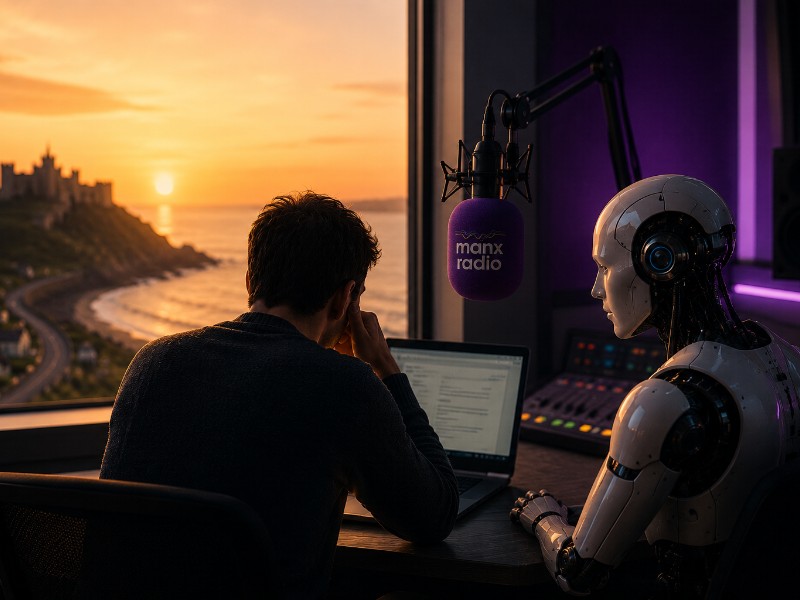
We were promised a 15-hour work week - so why does it feel like we're working more?
In 1930 John Maynard Keynes sat down to imagine a world his grandchildren would inhabit.
He didn’t see a world of endless toil; he saw a 15-hour work week.
He reasoned that as technological progress compounded the “economic problem” - the struggle for subsistence - would be solved.
He believed we would finally be free to focus on “how we use freedom from pressing economic cares”.
Nearly a century later, we have arrived at his deadline, yet the 15-hour week remains a ghost.
And many analysts argue we may be entering a second industrial revolution driven by generative artificial intelligence.
The promise is familiar: massive productivity gains, a surge in global GDP, and the automation of the mundane.
But for businesses the pressure to adopt is not theoretical, as Digital Isle of Man Chief Executive Lyle Wraxall warns - failing to embrace AI risks falling behind competitors who can “drop their prices” through increased productivity.
However, as we integrate these “thinking machines” into our offices a central tension has emerged: should we use AI to push GDP to unprecedented heights, or should we use it to purchase our time?
Is AI making us busier, not freer?
On paper, artificial intelligence looks like an economic miracle.
Current reports from the IMF and Goldman Sachs project that AI could boost global GDP by as much as $7 trillion (£5.26 trillion) over the next decade with annual productivity growth increases of up to 1.5 percent.
However, history warns us of the Jevons Paradox.
Named after 19th century economist William Stanley Jevons this phenomenon observes that as a resource becomes more efficient to use, we don’t use less of it.
Instead, the lower cost “unlocks” new demand leading to even greater total consumption.
In the 1860s, the resource was coal; today, the resource is human effort.
If AI makes writing a report 10 times faster, the theory suggests organisations are more likely to increase output expectations than reduce working hours.
Therefore, if the theory is to be believed, the lower ‘cost’ of a report will simply lead to a demand for 10 times as many reports.
Dr Fabian Stephany, a researcher at the University of Oxford notes, while AI should free up time, “that is not what we are seeing right now”, with early evidence suggesting we may be drifting toward a modern revival of this paradox.
With that in mind, it may be less of a case of being ‘liberated’, but rather an invitation to an ‘infinite backlog’ of new tasks, keeping us tied to our desks to oversee the very technology allegedly meant to set us free.
Is “more” better?
While the markets demand growth, the human engine is hitting a ceiling.
Recent research, including a systematic review in the Multidisciplinary Indonesian Centre Journal, describes the “always-on” culture as cannibalising the very productivity it seeks to protect.
Studies show that well-rested workers possess higher ‘cognitive endurance’. Vice versa, an exhausted worker using AI often falls victim to ‘automation bias’ - a state where we stop thinking critically and simply rubber stamp whatever the algorithm produces.
Some describe that as ‘workslop’: high volume, low-value output that may look professional on the surface, but lacks substance.
There is also a structural shift underway in the nature of work itself.
LEMA Logic founder Brian Gallagher observes if AI removes lower-intensity tasks, what remains is a concentration of “high mental focus” work - raising the risk that cognitive strain, rather than physical workload, becomes the new bottleneck.
That strain has real-world consequences.
Drawing on his experience in medicine, Dr Alex Allinson points to fatigue and burnout as the defining risks of sustained high performance, warning that stress rarely remains contained to the workplace, often spilling into family life.
Data from the 4 Day Week Foundation suggests an alternative approach.
As of early 2026, the BBC reported over 250 accredited UK firms have moved to a 32-hour week.
These companies saw productivity remain stable or even rise, while burnout plummeted.
This suggests an ‘organic growth’ model where by allowing AI to handle the cognitive heavy lifting, humans can revert to a sustainable work pace.
The resulting increase in morale and mental clarity drives GDP not through sheer volume, but through high-value innovation that tired brains simply cannot produce.
Gross Domestic Product vs Gross National Happiness
For nearly a century, Gross Domestic Product has been the undisputed king of metrics.
It was born in the industrial age to track how many tanks, tractors, and tins of beans a nation could churn out.
Think of GDP like a speedometer: it tells you how fast the car is going, but it doesn’t tell you if you’re heading toward a cliff, or if the passengers are happy.
A ‘wellbeing economy’ adds the dashboard. It measures mental health, environmental quality and ‘time wealth’ - the idea that free time is a currency as valuable as gold.
In the Nordic countries, this isn’t a fluffy concept; it’s a policy tool.
Towards the end of 2025, policymakers in parts of the Nordic region increasingly began discussing ‘digital wellbeing’ and how AI regulation could balance productivity with social cohesion.
Debates in countries including Finland and Iceland have increasingly focused on whether AI-driven productivity gains improve quality of life as well as economic output.
Instead of asking how much wealth AI creates, they are asking how that wealth improves ‘time use’ - a core pillar of the Gross National Happiness framework.
This is frequently described as the ‘leisure dividend’.
In a traditional GDP-focused economy, time saved by AI is instantly filled with more tasks. In a wellbeing economy, that time is viewed as a national asset, and the goal shifts from ‘doing more’ to ‘living better’.
How far is too far?
In an AI-augmented world, a choice needs to be made.
We can leverage AI to maximise output, which may lead to the so-called ‘nightmare scenario’ of abundance without sharing - a concept in which productivity gains are concentrated unevenly.
As AI consultant and founder of Archit3ct, Dan Thomas puts it, failing to increase output, businesses risk being “left behind”.
Or, we can view AI-driven productivity as a ‘time dividend’. If a task that once took 40 hours now takes 20, those remaining 20 hours could be returned to the worker.
Yet even this path is not straightforward.
Professor Raj Choudhury from the London School of Economics cautions that AI-driven productivity is not automatic - it depends on factors such as domain expertise and overcoming resistance to algorithmic tools - and may take far longer to scale than headline figures suggest.
Critics argue that pushing for additional GDP growth through AI, without addressing burnout, could create longer-term economic and social pressures.
But if we turn our attention to human nature itself, a wider question emerges, as Manx Technology Group Chair John Webster notes, while working hours have fallen significantly since Keynes’ era, our collective “wants” have remained effectively limitless - raising the possibility that the barrier to a 15-hour week is not technological, but cultural.
So, are we likely to move towards a 15-hour week as the world-renowned economist predicted?
Keynes wasn’t wrong about the capability of technology. He was perhaps too optimistic about our will to stop.
As 2030 approaches, the question is no longer “can we be more productive”, but rather “do we need to be?”
Listen
Listen to Manx Radio's documentary: "AI, Work and the 15-Hour Week":
 MHKs explain their 'no vote' decision in chief minister election
 Farmers union declares no faith in DEFA leadership
 Major incident declared as crews battled fire
 New 'rent-to-buy' option for first-time homeowners on the Isle of Man