Island to maintain its current policy approach
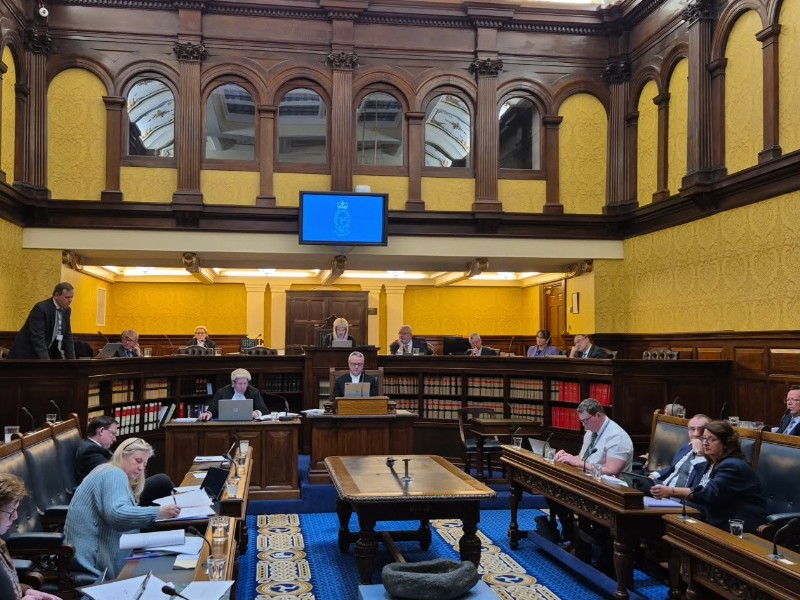
Tynwald has voted against holding a referendum on whether the Isle of Man should abandon its net-zero policy, following a wide-ranging debate in which members considered legal, practical and ethical implications of putting the question to the public.
The motion, brought by Middle MHK Stu Peters, called for a vote to be held alongside the next General Election on 24 September 2026.
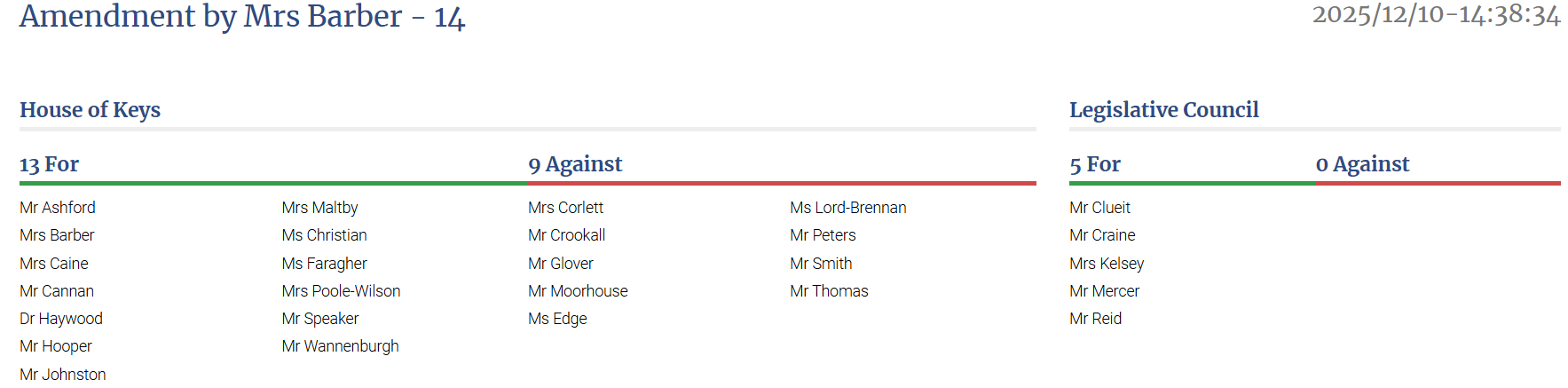
However, an amendment from Environment, Food and Agriculture Minister Clare Barber - which removed the referendum proposal and reaffirmed the existing policy approach - was approved, meaning the referendum will not proceed.
The Climate Change Act 2021 commits the Island to achieving net-zero carbon emissions, and the Referendum Act 1979 - under which Mr Peters sought to hold the vote - has never been used.
Ahead of the sitting, the Isle of Man Green Party issued a public statement opposing a referendum on abandoning the policy, arguing that the Island’s net-zero framework provides long-term stability for energy security, infrastructure planning and economic transition.
Peters: “This is about allowing the public their say”
Opening the debate, Mr Peters says his proposal was not about opposing climate action, but about giving residents a direct say on a policy he argued would not influence global climate outcomes. He says many people might prefer public funds to be directed towards infrastructure, education and health, and suggested the cost of a referendum would be minimal if added to existing ballot papers.
Mr Peters says those confident in public backing for net-zero “have nothing to fear” from a vote and suggested turnout could increase. Opposing his motion, he argued, meant believing “government knows best” on what he described as a globally insignificant issue.
He rejected the government amendment, calling it “a cop-out”.
Barber: Motion “not in the Island’s best interests”
Environment, Food and Agriculture Minister Clare Barber says the proposal was not pragmatic and that public sentiment can already be reflected through the General Election. She says climate change is consistently raised as a priority issue by constituents and warned that referendums are vulnerable to misinformation.
Mrs Barber also highlighted concerns with the Referendum Act, which does not specify whether results are binding. Reversing climate commitments, she says, could jeopardise the Island’s reputation and relationships under international agreements, including the Paris Agreement.
She refuted claims that climate action involves “eye-watering costs”, saying around £8 million spent in recent years had gone towards improving household energy efficiency. She says climate impacts are accelerating and delaying action will increase future costs.
Her amendment to remove the referendum proposal and maintain the current policy approach was later approved.
Chief Minister: A binary vote “does not reflect the complexity”
Chief Minister Alfred Cannan questioned what a referendum outcome would actually signify, asking whether a “no” vote would reflect opposition to renewable energy, support for fossil fuels or concerns about infrastructure siting. He says government should continue exploring the benefits of renewable projects, including lower long-term costs and improved energy security.
He argued that a single yes-or-no vote would not “do justice to the complexity” of the issue and confirmed he would not support the motion.
Attorney General: Legal risks within the referendum framework
Attorney General Walter Wannenburgh says the Referendum Act 1979 places the deemsters in roles that risk compromising judicial independence, creating the perception they were participating in law-making. Under the existing legislation, deemsters would be required to set the question posed in referenda. He warned this could expose judges to lobbying and undermine public confidence.
He emphasised his comments were not political, but says substantive legislative amendments would be required before any referendum could be conducted under a modern framework.
Craine: Science “cannot be put to a public vote”
MLC Paul Craine says referendums can be appropriate for constitutional matters, but this proposal was “tactical” and inappropriate. He says Mr Peters had previously described climate change as a “religion” and “cult” and claimed scientists were lying - assertions he says misrepresented mainstream science.
He argued a referendum would pit scientific evidence against public opinion and would not resolve differences of view. He says the transition away from fossil fuels offers economic, environmental and health benefits, and warned a referendum would be “incredibly divisive”.
Mercer: Referendum “destabilises, rather than deepens, democracy”
MLC Rob Mercer says simple, binary choices can feel attractive but do not reflect the complexity of climate policy. He argued that responsible government must rely on scientific analysis rather than “cherry-picked” online material.
He says the motion attempted to “crash a legal framework that already exists” and would destabilise democratic processes rather than strengthen them.
Wannenburgh: Long-term strategy “not suited to a binary question”
Douglas North MHK John Wannenburgh says he supported the Island’s climate goals but could not back a referendum on such a long-term strategic issue. He says some targets may be over-ambitious and require review, but policy should be shaped by elected members, not a referendum.
He noted he had supported a referendum on assisted dying, but says climate policy differs because it extends over decades. He says achieving net-zero is central to long-term energy resilience and confirmed he would vote against the motion.
Clueit: Risk of “conspiracy theories and culture-war narratives”
MLC Gary Clueit says Mr Peters was “forum shopping” and argued Tynwald already provides democratic legitimacy. He says the Referendum Act was intended for constitutional issues, not complex technical policy questions.
Mr Clueit warned a referendum campaign would likely feature misinformation, referencing comments Mr Peters had previously made about climate science. Drawing parallels with the Brexit campaign, he says claims cannot be adequately regulated in such a contest.
He argued abandoning net-zero would leave the Island heavily dependent on fossil fuels and threaten future prosperity. He urged Tynwald to reject the motion.
Lord-Brennan: Public “wants a direct say”
Glenfaba and Peel MHK Kate Lord-Brennan says she supported the motion, arguing that public desire for a direct say was “deep and strong”. She says the Climate Change Act binds the Island to targets that are unlikely to be met and argued a referendum would be a democratic means of gauging public sentiment.
She acknowledged many believe climate policy should be an election issue but says she wanted to support the principle underlying Mr Peters’ proposal.
Ashford: Referendum risks division “as seen across” the UK
Cabinet Office Minister David Ashford says the motion reduced a complex, multi-layered issue to a binary question. He warned that referendums can cause significant division, citing the experience of the UK, and says the result would reflect only those who choose to vote.
He raised concerns about blurred lines between candidate spending in a general election and referendum campaigning. He says the motion risked drawing the judiciary into political matters and argued referendums are not a substitute for representative democracy.
Thomas: “Democracy and science evolve”
Douglas Central MHK Chris Thomas says the motion focused specifically on the policy of achieving net-zero emissions, not the broader law. He says both democracy and science evolve and argued that the Referendum Act could be amended in time for a vote.
He says the General Election could prompt changes to climate policy but believed a referendum could still play a role. He says he would support the original motion.
Moorhouse: Concerns over “eye-watering costs”
Arbory, Castletown and Malew MHK Jason Moorhouse says net-zero costs affect “every element” of government and expressed concern about what he described as reliance on uncertain financial projections. He says the Isle of Man already has a strong environmental profile and raised concerns about revised cost estimates for renewable energy projects.
He says comments from the Attorney General and others about the practicalities of a referendum needed careful consideration.
Haywood: Referendum is a “blunt tool” for a complex issue
Infrastructure Minister Michelle Haywood says net-zero is already embedded across government work and cannot easily be disentangled. She says renewable energy is economically favourable in the long-term and argued delayed action on climate change leads to higher costs.
She warned that misinformation from fossil-fuel-linked interests can distort public debate and says a referendum would be an unsuitable mechanism for a highly complex policy area. She confirmed she would not support the motion.
Hooper: “What exactly would we stop doing?”
Ramsey MHK Lawrie Hooper says many actions associated with net-zero - such as lowering energy costs and improving food security - would need to continue regardless. He questioned which specific measures Mr Peters believed should be halted if the referendum produced the result he sought.
He noted that no petitions had been submitted on Tynwald Day calling for climate action to be reconsidered and argued that abandoning the Act or the underlying policy required clarity about which elements would be removed.
Johnston: Referendum risks politicising long-term planning
Enterprise Minister Tim Johnston says climate policy affects every resident and business and brings opportunities for energy security and economic development. Drawing on his experience in farming, he says environmental changes are already being felt.
He argued that a referendum risks politicising an issue that should be guided by evidence and long-term planning and says a vote held alongside a general election could undermine ongoing work. He warned of setting a precedent where complex policy decisions are delegated to public ballots.
Faragher: Referendum risks ‘division and distortion’
Douglas East MHK Joney Faragher says decades of evidence underpin the scientific understanding of climate change. She says much of the Island’s climate-related spending focuses on improving energy efficiency in homes.
She argued that vested interests could unduly influence a referendum campaign and says a vote risked division similar to that seen after the Brexit referendum.
Crookall: Targets unrealistic, but legal issues decisive
Glenfaba and Peel MHK Tim Crookall says he believed a referendum result might contradict expectations but described the Island’s net-zero targets as unrealistic. However, he says the legal concerns raised by the Attorney General were decisive, and he could not support the motion while the Referendum Act remains unchanged.
Edge: Public concern about costs should be heard
Onchan MHK Julie Edge says many constituents feel they have not had a say in spending decisions linked to climate policy. She supported updating the Referendum Act and says the motion sought only to measure public opinion, not dictate specific outcomes.
She expressed concern about transparency over the costs of renewable energy projects and says she would support the motion.
Corlett: Referendum could reconnect public feeling
Douglas Central MHK Ann Corlett says many residents feel alienated from decision-making and argued that suggesting the issue is too complex for public input can feel patronising. She says she did not have a clear sense of her constituents’ views and wanted to support Mr Peters’ attempt to ‘promote democratic engagement’.
Glover: Constituents want their say after wind-farm controversy
Arbory, Castletown and Malew MHK Tim Glover says he had been unsettled by some of the language used during the debate. He says a number of constituents felt excluded from decisions about wind-farm proposals and argued referendum mechanisms could be clarified through legislative work by Tynwald.
Outcome
After several hours of debate, members voted in favour of the amendment brought by Mrs Barber, which removed the referendum proposal and described the General Election as an opportunity for “all matters” to be democratically considered.
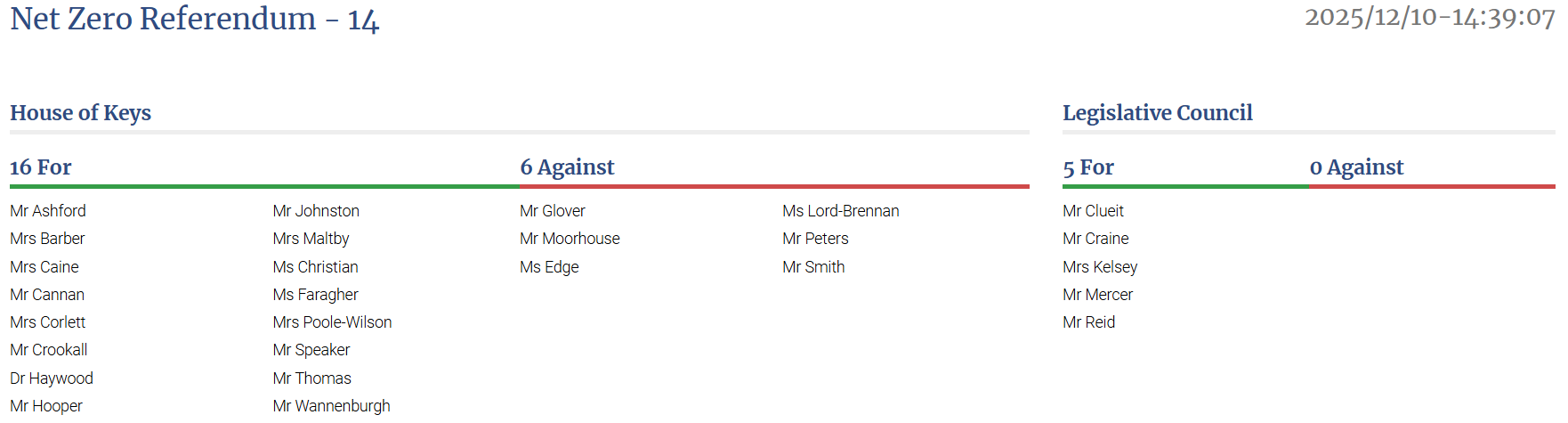
As a result, Mr Peters’ motion was rejected and no referendum will be held.
 ICO proposes revised data protection fee model after consultation
 'We can persevere in the face of uncertainty'
 Incapacity benefit claims remain stable as annual cost rises to over £15 million
 DoI 'carried out inadequate searches' in response to FoI
 Bowel cancer awareness campaign returns with Island-wide initiative