

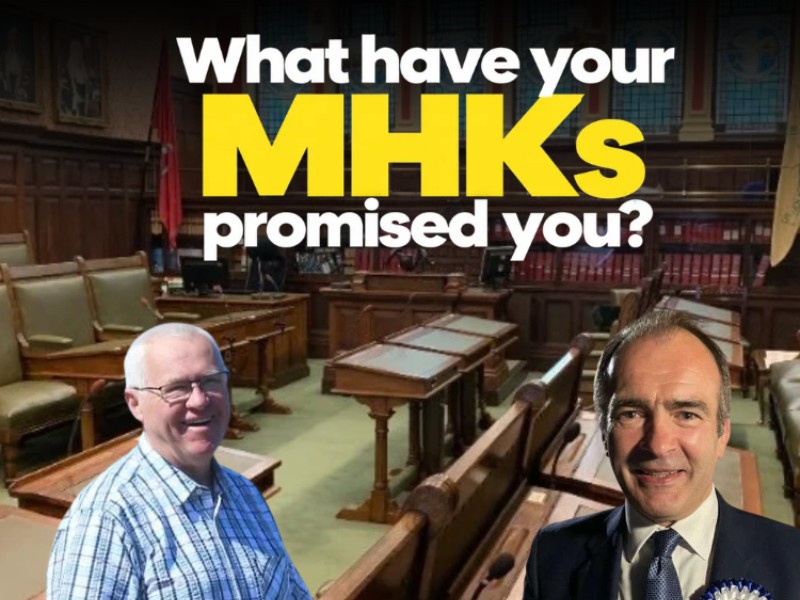
Stephen Broad and Alfred Cannan were elected
The constituency of Ayre & Michael has returned two very different politicians to the House of Keys. Chief Minister Alfred Cannan, the first sitting Chief Minister to defend his constituency seat since Donald Gelling in 2001, retains his position at the top of government. Joining him is political newcomer Stephen Broad, a businessman and former Special Constable who topped the poll.
Below is a summary of where both men stand on the major issues facing the island, drawn from their manifestos and statements during the election campaign.
Housing
Mr Cannan's flagship housing policy is the creation of a dedicated, arm's-length Housing Association based on Jersey's Andium Homes model. This body would unify public housing stock and management, integrating the Manx Development Corporation into a single professional delivery organisation to replace the fragmented DOI Housing Agency.
In addition, Mr Cannan supports a government-backed zero-deposit mortgage and guarantor scheme for first-time buyers, an accessible Rent-to-Buy programme, and the index-linking of first-time buyer scheme thresholds to wages and house prices. He also wants to continue the Island Infrastructure Scheme to encourage brownfield redevelopment.
Mr Cannan has acknowledged that the pace of house building, currently around 200 homes per year, has been "disappointingly slow" and has admitted that a previous attempt to establish a housing association failed to gain sufficient political support.
Mr Broad's approach to housing focuses on deregulation and making better use of existing property stock. He wants a simple, non-bureaucratic route for converting empty commercial buildings in towns and villages into homes, arguing this would stimulate construction and expand access to affordable housing.
He also supports reviving the Petition on Permitted Development that was presented to Tynwald in July 2026.
Mr Broad links housing to immigration policy and argues that the 2001 Residence Act should be implemented to regulate who can buy and rent property on the island. He believes this would help prevent English companies purchasing Manx properties for rental purposes at the expense of young local people, although he presents the Residence Act primarily as an immigration and population-control measure rather than a housing policy.
Energy
Mr Cannan has said he has heard clearly from constituents that they are not opposed to renewable energy itself, but that they do not believe the benefits for the Isle of Man have been properly demonstrated. He agrees with that assessment.
Mr Cannan believes any offshore wind farm proposal should be studied carefully. Even if planning approval is granted, he argues serious questions remain around financial returns, the cost of directing power to the island, infrastructure investment, decommissioning liabilities and environmental impacts. He has also stated that if the Orsted project proceeds, he would oppose any further consideration of onshore wind turbines at Earystane. Alongside this, he supports solar generation for both the national grid and private properties, backs public-private energy partnerships where they can reduce prices, supports continued scrutiny of a second interconnector, and wants a clear assessment of the costs involved in upgrading the electricity grid and improving home insulation.
Mr Broad has adopted a firm position against both the Mooir Vannin offshore wind farm and the Cair Vie onshore wind farm.
He says opposition among constituents is one reason for his stance, while the economics of the projects form the second. He questions whether the power station built by the MEA more than twenty years ago has been fully paid for and argues that the infrastructure needed for large-scale onshore wind development would be extensive, expensive to import and costly to maintain.
However, Mr Broad is not opposed to renewable energy in principle. He supports tidal stream technology, solar power and appropriately located small-scale wind projects. He also argues that public consultation must come first, with clear remits and boundaries established before contracts are awarded.
Government Reform
Government reform is the centrepiece of Mr Cannan's manifesto. He proposes a Government Reform Act that would fundamentally restructure the Isle of Man Government.
Under his plans, policy-making would be separated from operational delivery, with all policy development centralised within a core Policy Unit while departments concentrate on delivering services such as healthcare, education and infrastructure. He also wants to strengthen the Operational Performance Board, allowing it to audit government structures, reduce management layers, impose efficiency targets and place underperforming bodies into special measures. His proposals include statutory limits on the number of chief officers and management hierarchy positions within departments, formal oversight arrangements for arm's-length bodies and regulators, and potential reforms covering referendums, ministerial government and Treasury control over severance payments.
Mr Cannan has admitted previous reform efforts failed because ministers operating in departmental silos did not deliver the required changes. He now believes legislation is necessary to force reform. He has also pledged to publish quarterly staffing reports and annual departmental business plans.
Mr Broad argues that the Executive has become too powerful and that collective responsibility allows the Council of Ministers and departmental members to push legislation through the House of Keys without sufficient scrutiny.
His proposals include reducing the influence of the block vote so that a majority of elected representatives must support legislation. He also wants to explore giving the Chief Minister greater authority to restrain the Council of Ministers, including the possibility of a veto power or the ability to trigger referendums on contentious issues, although he presents these as ideas for consideration rather than firm commitments. In addition, Mr Broad wants an independent review of government operations by external experts, believing meaningful reform cannot be delivered from within the system itself. He also supports directly elected Members of the Legislative Council with a clearly defined scrutiny function separate from policy-making.
Mr Broad further advocates revisiting Sir Miles Walker's 2006 report on the structure and scope of government, which warned that the size of government could eventually exceed the economy's capacity to sustain it.
The Economy
Mr Cannan's economic platform is built around fiscal discipline and diversified growth.
He has highlighted a £50 million gap in the government's finances and argues that every department should prepare fully costed scenarios showing how spending could be reduced by 5% and 10%. He opposes raising personal taxation unless absolutely necessary and supports increasing the personal tax-free allowance.
Mr Cannan also wants to restructure the Finance and Digital Agencies into a public-private partnership similar to Jersey Finance, with clear growth targets across banking, insurance, wealth management, corporate services and digital commerce. He supports reviewing the Financial Supervision Authority to improve efficiency and introduce a secondary competitiveness mandate. Other proposals include renewing focus on engineering and manufacturing, enhancing the Skills Board's role in workforce planning, expanding apprenticeships in trades such as plumbing and construction, transforming Visit Isle of Man into an independent board with measurable objectives, independently reviewing the Steam Packet's financial model, and maintaining an open-skies policy while ensuring government intervention delivers value for money. He has also proposed a Food Security and Local Agriculture Act that would encourage public sector organisations to procure local produce and seek agreed targets for stocking Manx products in supermarkets.
Mr Broad's economic philosophy is that wealth is generated by the private sector rather than government. He argues that an expanding bureaucracy is holding back enterprise and economic growth.
His priorities include halting the growth of government, reducing bureaucracy and questioning the need for multiple chief officers across departments. He supports light-touch regulation and low taxation to attract investment, arguing that excessive regulation has damaged sectors such as e-gaming and contributed to the decline of banking services in the north of the island. Mr Broad also wants the island to focus on niche strengths such as data trusts rather than spreading resources too thinly, while giving local businesses greater freedom to grow and prosper.
He has also linked economic reform to planning reform, arguing that the current system is obstructing development. As a result, he supports reviving the Petition on Permitted Development and simplifying the process of converting commercial premises into residential properties.
Education
Mr Cannan points to the introduction of an independent quality assurance system for schools as one of the achievements of the last administration and wants to build on that progress.
His plans include giving teachers, head teachers and governors greater operational autonomy, supporting University College Isle of Man in expanding technical and vocational education, and strengthening lifelong learning through collaboration with the Skills Board. He also wants to continue Junior Achievement programmes, reintroduce work experience opportunities, review regulations affecting part-time employment for young people, address concerns about children entering school without basic behavioural and developmental skills, review Special Educational Needs provision, and support a First 1000 Days policy to help parents give children the best possible start in life. This could include legislation focused on parental support, limiting excessive screen use among young children, and encouraging language development and play.
Mr Broad's manifesto did not contain a detailed education policy. However, during the campaign he referred to his experience supporting vulnerable young people between 2013 and 2019 who he believes were failed by the Manx education system. He has also spoken about the importance of electing what he describes as "decent people" with common sense to both the House of Keys and the Legislative Council.
His emphasis on vocational training and apprenticeships aligns closely with his wider economic agenda of developing a skilled local workforce, although he does not present these proposals specifically as education policy.
Steam Packet and Connectivity
Mr Cannan's manifesto committed to examining the financial model of the Steam Packet and its related ship strategy independently, with the aim of ensuring best value for freight customers and passengers. The manifesto states that options for change will be presented following this review.
On air connectivity, Cannan's manifesto supports the current open skies policy, but with a caveat: government intervention should also be required to demonstrate value for money. This sits within the Strategic Air Services Policy, which was approved by Tynwald and sets a framework for when and how government should intervene to secure core routes to London, north-west England, and Dublin, as well as developing additional regional connectivity.
Mr Broad set out that the Steam Packet could be better used to stimulate the economy and provide a boost to farmers. He also emphasised a move away from the current arms-length model.
He stated that government must be "effective, productive, and focused on what it actually delivers to the people" and criticises the size and cost of government. In his interview, he argued that the MEA power station was built over 20 years ago and questioned whether it had been paid for—a critique that reflects his wider skepticism about major government capital projects and their financial management.
His constitutional reform proposals—reducing the power of the block vote and exploring greater authority for the Chief Minister—are relevant to how decisions about major infrastructure like the Steam Packet are made. Broad's core argument is that the direction of government should come from the people and businesses through their MHKs, not from the Executive, and this principle would apply to how the island's connectivity is managed.
Local Government Reform
Mr Cannan's proposed Local Communities Bill is one of the three flagship legislative measures in his manifesto. It is intended to protect valued local services, particularly village shops, pubs and sub-post offices, which he describes as essential to thriving rural communities.
He has pledged to seek leave from the House of Keys to introduce the legislation at the first regular sitting of the new parliament. He also wants to work closely with local commissioners to improve quality of life, consult on the All-Island Strategic Plan, support local retailers and businesses, continue backing Jurby as both a business park and village community, and ensure local concerns are reflected in decision-making.
Mr Broad has not proposed a specific programme of local government reform. However, his wider constitutional reforms would have significant implications for democratic decision-making across the island, including at a local level.
These proposals include directly elected Members of the Legislative Council with a dedicated scrutiny role, reducing the influence of the block vote in the House of Keys, exploring greater powers for the Chief Minister to restrain the Council of Ministers, and reviving the Petition on Permitted Development to give communities more influence over planning matters.
Mr Broad's underlying philosophy is that government should take its direction from the people and businesses of the island through their elected representatives rather than from the Executive. Although these are national constitutional reforms rather than local government policies, they would significantly alter how decisions affecting local communities are made.
 How to pick a Chief Minister
 Liverpool man banned from Island
 Former Red Arrows pilot recalls engine cut-out
 Auditor General criticises lack of progress