


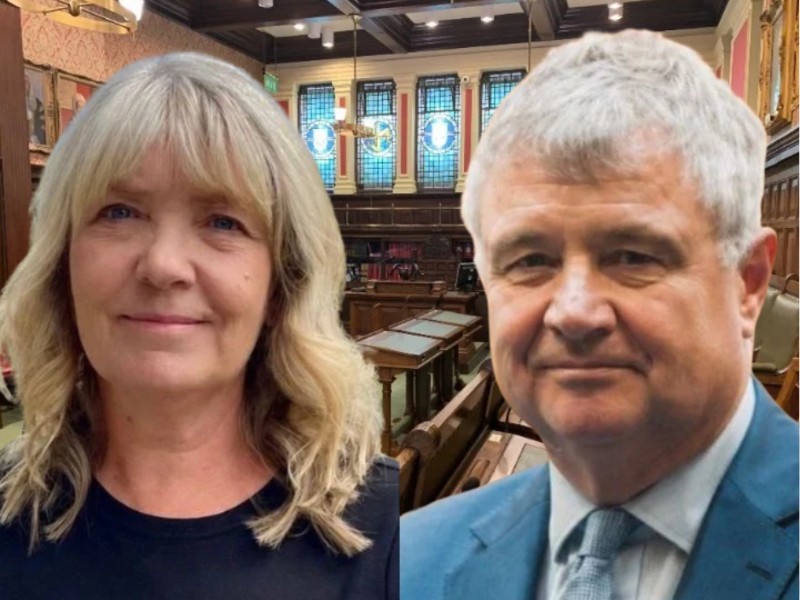
Andy Saunders and Joney Faragher were elected
Voters in Douglas East chose to blend experience with a newcomer when they picked their MHKs. Andy Saunders, owner of Quids Inn topped the poll, with Manx Labour Party leader Joney Faragher taking the second seat.
Their campaigns both offered change for the capital and the Island. Here is a breakdown of where they stand on the critical issues that will define the next five years:
Housing
Both candidates treated housing as a central priority, but they came at it from different angles.
Mr Saunders framed housing as a family issue, recalling how his son had told him he doubted he would ever own a home on the island. His manifesto committed to helping local authorities build more social housing, improving first-time buyer schemes, strengthening affordable home build requirements, discouraging large buy-to-let investors, and reviewing residency regulations to support locals. He also wanted to see the stalled Park Road school site delivered with affordable housing built on released land.
Ms Faragher acknowledged the government's completed assessment of housing need had provided the data, but argued the focus must now shift immediately from assessment to delivery. She welcomed July's Tynwald changes to first-time buyer schemes and the lifting of thresholds but warned that neither First Home Fixed nor First Home Choice actually built new homes, something she said must be the first strand of any plan to bring young Manx people back to the island.
Energy
The potential Mooir Vannin wind farm off the island's east coast was a live issue for Douglas East constituents and the two candidates diverged somewhat here.
Ms Faragher supported renewable energy in principle, arguing it was the route to cheaper bills and energy security. But she stressed that the environmental impact, visual impact on the skyline and connectivity issues had to be properly assessed and that if the project went ahead, negotiating the lease would be critical, ensuring the island secured a percentage of its energy needs and bridged the budget deficit gap.
Mr Saunders did not address the wind farm directly in his manifesto or interview, instead framing energy costs as one of the core pressures on small businesses, alongside employment costs and rents. His broader position was that government must create the conditions for business to thrive rather than adding costs.
Government Reform
This was Mr Saunders' signature issue. He described eight government departments operating as silos, all fighting against each other and called for a central administrative hub to end duplication in data collection and back-office functions. The savings, he argued, should be redirected to frontline services such as doctors, nurses, hedge cutters, pothole fillers and police officers.
He also wanted open government, all contracts and tenders made public, figures published sooner, better digital access to data, more weight given to consultation responses, and consideration of citizens' assemblies on core topics. He was candid that modernisation would not be perfect within five years and that mistakes would be made, arguing that a fear of error was preventing anyone from grasping the nettle.
Ms Faragher approached reform from inside the system, having served as a political member for DHSC and then DOL. She argued that her five years of experience were the qualification for the next five, pointing to her work overseeing CQC inspections, championing CAMHS improvements, and bringing through a private member's bill on period poverty.
She was open to serving as a minister again, but only under a chief minister she was politically aligned with. As leader of the Manx Labour Party, she also defended the party's record of allowing members to vote according to conscience on certain issues, arguing that the island's consensus politics was a strength, not a weakness.
The Economy
Mr Saunders was emphatic that government should stay out of small businesses' way. He claimed small businesses generated around 80% of the island's income and that excessive legislation and red tape were holding them back.
His manifesto committed to supporting core sectors such as tourism, retail, agriculture, manufacturing and finance, by making it easier and cheaper to get on and off the island for visitors, people and freight; encouraging training in needed skills; legislating to make business development easier; incentivising town centre events; discouraging empty properties; supporting rezoning for housing; and encouraging startup hubs in towns.
He also wanted less bureaucracy, more available banking provision, and cheaper costs of doing business.
Ms Faragher took a more interventionist line. She voted against the government's U-turn on aligning the minimum wage with the living wage, arguing the Island should have stuck with the poverty committee's recommendation and provided support mechanisms for smaller businesses to absorb the change.
She highlighted the poverty committee's second report on the attainment gap as a more positive example of government accepting recommendations. On town centres and business costs, she admitted she did not have all the answers but wanted to review whether government investment could support businesses with rents, arguing that rent was discussed far less than wage pressures.
Education
Mr Saunders argued Douglas East had more young people than almost any other jurisdiction and that a new school was far from on the radar for completion despite being an urgent case.
He also wanted more spaces in primary schools, a greater focus on vocational skills, a sixth form college of excellence and modular higher education paths. He floated incentivising developers to build housing on the Murray's Road and Ballakermeen campuses once new school provision was in place.
Ms Faragher pointed to the poverty committee's report on the attainment gap between children from low-income families and their peers, which found that some schools had successfully closed the gap while others had not. She argued the next administration must find out what those schools did and replicate it Island-wide, describing closing that gap as the outcome the committee was trying to achieve.
She also highlighted free school meals and free bus travel for school students as areas for further work, and warned that politics was currently orientated around the 55–60+ age group rather than decisions that positively impacted children and young people.
Steam Packet and Connectivity
Mr Saunders identified the cost of Steam Packet tickets as the single biggest hurdle to growing the visitor economy.
Crucially, he did not blame the company, arguing it had done a good job serving its shareholder's interest in generating income, but that government should refocus its mandate towards getting as many people onto the island as often as possible. He was confident that once visitors arrived, they almost always returned.
Ms Faragher said her transport focus was on local infrastructure. She has pushed two motions to bring bus facilities to Lower Douglas, and while she was disappointed that toilet facilities were not included, she secured a plan for a two-area succession of stops at Victoria Street and the edge of the promenade, with appropriate shelters.
She said she will continue to improved public facilities
Local Government
Mr Saunders had never served on Douglas Borough Council and suggested he could make more of a difference at national level, having dealt with government from the outside for years. His local commitments included reinvigorating the Promenade Walkway and its surroundings, bringing back horse trams without business disruption, a bustling city centre ideally with locally owned businesses, keeping Nobles Park for people and families, maintaining infrastructure and tourism attractions, and fair parking controls for residents.
Ms Faragher committed to working to lifting the standard of the capital city and continuing to fight for bus facilities for residents of the capital.
 Chief Minister candidates take questions from MHKs
 German supermarket giant has 'noted interest' in Island
 Stab wound force 'at severe end of scale'
 Polls open for Marown Commissioners by-election