
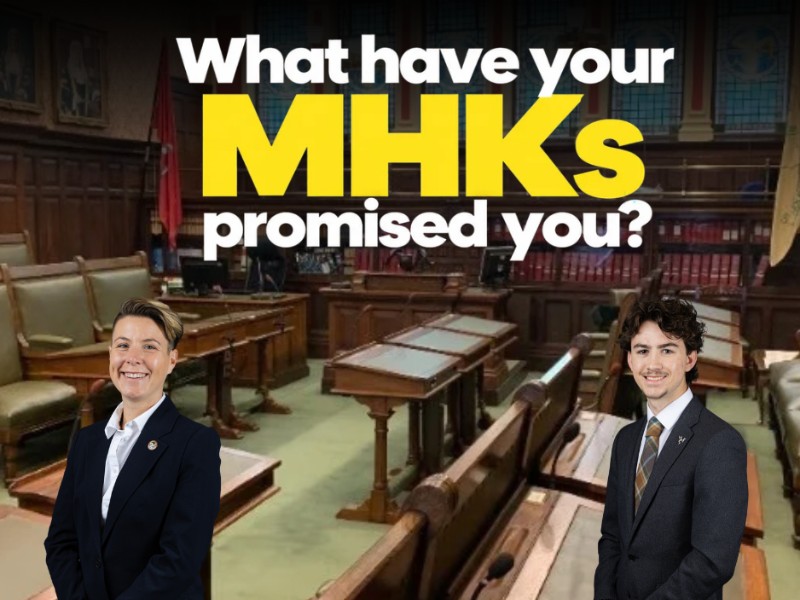
Katryna Baptist and Daniel Davison were elected
Glenfaba and Peel has two new MHKs, Katryna Baptist topped the poll, with Daniel Davison taking the second seat. Both are new to the House of Keys, both ran on change, but what can voters expect over the coming five years?
Housing
Mrs Baptist made housing one of her headline priorities. She described the Island's housing market as fundamentally different from the UK and argued that unlike the UK, there is nowhere cheaper for young people to move to.
Her proposals included increasing land registry fees for second homes and off-Island investors and ring-fencing that money for affordable housing, creating a rent-to-buy scheme, increasing social housing, mandating 1–2 bedroom properties in new developments, removing mortgage-interest tax relief for investment properties and using compulsory purchase powers for derelict buildings.
Mr Davison described housing as the issue people raise with him before he has finished asking the question. He wanted first-time buyer price caps and income limits reviewed annually against real prices and wages, arguing that 'you'll have a system that works on paper but doesn't work practically'.
He supported higher rates on second homes and empty properties, particularly those owned by non-residents and wants more social housing reviewed as circumstances change 'so a family home is freed up when it is no longer needed, rather than allocated for life'.
Both candidates also linked housing to youth retention
Energy
Both candidates opposde the current Mooir Vannin wind farm proposal, though with different emphases.
Mr Davison has been unequivocal saying there proposal has too many uncertainties and places too much risk on the Island.
He has said he is not against clean energy but is 'against the deal on what's been published so far' and that if the terms change with a genuine guaranteed benefit, he would look again. He has also called for support for households and farms that generate their own power, with a fair rate for what they feed back.
Mrs Baptist has said she "genuinely can't support something that I don't know enough about."
She expressed concern about the visual impact on tourism, argued it is 'alternative energy' rather than green energy and said she wants all options and data laid out before a decision. She has praised UK moves to make solar panels more accessible and said solutions that directly benefit residents would be 'a win-win'.
Government Reform
Both candidates campaigned on transparency and accountability, but their approaches differ.
Mrs Baptist submitted a petition to Tynwald in June calling for reform of local and national government and has said she intends to bring it before Tynwald if elected.
Her proposals include annual performance, behaviour, training and development reviews for civil servants.
She also spoke about publishing project plans with red-amber-green status so the public can see what is on time and on budget. Her experience as a Peel commissioner is central to this: she has said she 'identified some areas that needed some work, some malpractice, some maladministration' and found 'there was nowhere to turn'.
Mr Davison focused on the structural imbalance in Manx politics. He has argued that 'around 80% of MHKs in some form of government job' leaves no effective counterbalance and that the system lacks agency and mandate.
His central proposal is new laws to bring the public in as a counterbalance, not to run everything by referendum, but to 'rebalance the system so that government has to pay attention to the public and has a real mandate to make changes and get things done'.
He also supported the option of a public vote on who becomes Chief Minister, and wants MHKs given departmental roles according to their skills and experience. He has also said departments should be made to work as one government, 'each justifying its budget and reporting honestly on time and cost'.
Both also spoke about the size of the civil service and the public desire to see it reduced.
The Economy
Mrs Baptist approached the economy from a business background. She has worked in large regulated businesses, taught business at degree level and run several successful businesses on the Island, most recently a guest house in Peel.
Her manifesto proposals include a Manx-first ethos to government procurement, streamlining processes to be more agile for SMEs, leveraging the Island's independence and financial expertise in AI, and becoming the "Go To" nation for ethical AI governance.
She has also spoken about the need to attract businesses with an outstanding marketing plan and to remove barriers to payment solutions for digital creators.
Mr Davison runs two businesses himself and focused on the practical barriers facing small firms.
He has argued that grants are 'impossible to get from the government' and that what should count is 'whether you know your trade, you know your business, and you know your figures' rather than 'how well a form is filled in' and wanted the case for a higher VAT threshold made properly with the UK and made in public, arguing that the current threshold tells businesses to 'stop growing at the moment they were about to take somebody on'.
He supported a Manx-first approach to government purchasing and a review of red tape. He has also said the cost of getting on and off the Island is 'now a business issue as much as it is a family one'.
Education
Mrs Baptist proposed allowing teachers the freedom to review and adapt the curriculum, connecting knowledge with a future-focused curriculum across subjects rather than isolating them into silos, teaching digital responsibility and real-world problem solving and focusing on aptitude and skills 'not simply testing students' ability to recall and preparing for exams'.
She also called for better support for those with different needs, reviewing school meals with a Manx-produce first ethos, and developing strong educational leaders through apprenticeships, training and leadership programmes.
Mr Davison focused on vocational routes and youth retention.
He has said 'we tell young people to go away, get qualified, come back and get a job, but less and less are doing it every year, and then we wonder why'.
His proposals included reviewing the apprenticeship scheme and weighting it towards the first year, when an apprentice costs a small firm more than they bring in.
Steam Packet and Connectivity
Mr Davison proposed a cap on Steam Packet fares over the holidays and a proper resident discount, 'set by government as the owner of the company'.
He also called for demand-based pricing to be reviewed, arguing that 'the only route on and off the Island should not punish people for needing it'. He has said the two race fortnights, the TT and the Manx Grand Prix, should be 'backed properly so they recover rather than drift', and that the west should be 'sold properly to visitors as a destination in its own right'.
Mrs Baptist has described the Steam Packet as 'the most talked about barrier to tourism', either because of reliability or cost.
She said the Island has to be more competitive and compelling. Not just a 'hidden gem.'
Her manifesto included a commitment to better connections, specifically 'a bus service that considers flight schedules, and that takes UCM students straight to college'.
Local Government
Mrs Baptist was Peel Town Commissioner and described that experience as formative and has called for improved dialogue between commissioners and central government and between central government and constituents.
Mr Davison has said he would 'work closely' with the local authorities in the constituency and hold regular surgeries in Peel and out in the villages. framing his approach as one of collaboration with the authorities.
 Douglas Council could undergo independent review of its organisation
 Children’s charity commemorates babies and infants with ribbon display
 Government to sit down with MNFU after leadership criticism
 GNAAS raises more than £1million in fundraising appeal for third helicopter