
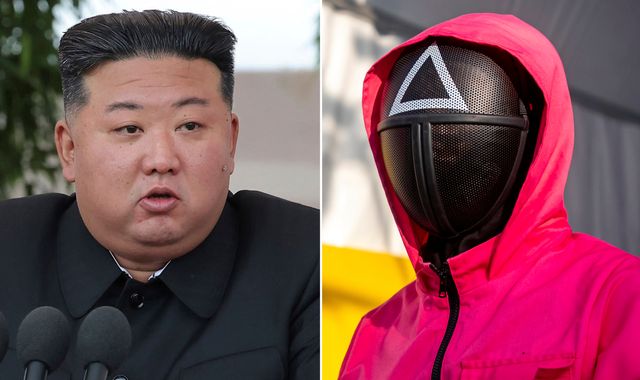
People in North Korea, including schoolchildren, are being executed for watching Squid Game and other foreign media, according to new testimony.
Citizens also face being killed for listening to K-pop, a South Korean music genre that includes bands like BTS.
Interviewees have described a climate of fear in which the South's culture is treated as a serious crime.
The less well-off are more likely to suffer the harshest punishments, while wealthier North Koreans are able to pay corrupt officials to dodge prosecution, it is claimed.
The testimonies were revealed by Amnesty International after conducting 25 in-depth interviews with escapees who have fled the secretive state run by Kim Jong-un's regime.
The escapees said watching globally popular South Korean dramas, such as Squid Game, Crash Landing on You, and Descendants of the Sun, can lead to the most extreme consequences, including death.
'Multiple executions'
One interviewee said they heard from an escapee with family links how people, including high school students, had been executed for watching Squid Game in Yanggang Province, which is close to the Chinese border.
Another execution for distributing the South Korean show was previously documented by Radio Free Asia in neighbouring North Hamgyong Province in 2021.
"Taken together, these reports from different provinces suggest multiple executions related to the shows," Amnesty said in a statement.
Interviewees also described the perils of listening to foreign music, particularly K-pop from South Korea, with the popular band BTS named in their testimony.
In 2021, The Korea Times reported that a group of teenagers were caught and investigated for listening to the group in South Pyongan Province, which neighbours the capital, Pyongyang.
'Homes sold to avoid re-education camps'
Choi Suvin, who fled North Korea in 2019, said people would sell their own homes to avoid punishment.
"People are caught for the same act, but punishment depends entirely on money," the 39-year-old said.
"People without money sell their houses to gather $5,000 or $10,000 to pay to get out of the re-education camps."
This inequality was further evidenced by the case of Kim Joonsik, who was caught three times watching South Korean dramas, but avoided punishment because his family had connections.
The 28-year-old, who left the country in 2019, said: "Usually when high school students are caught, if their family has money, they just get warnings.
"I didn't receive legal punishment because we had connections."
He contrasted his fate with that of three of his sister's school friends.
In the late 2010s, the girls were condemned to years-long sentences in North Korea's labour camps because their families could not afford bribes.
'Executions to brainwash'
People, including schoolchildren, were made to attend public executions as part of their "ideological education", the interviewees said.
Ms Choi described seeing someone executed for allegedly distributing foreign media in 2017 or 2018, in Sinuiju, near the Chinese border.
"Authorities told everyone to go, and tens of thousands of people from Sinuiju city gathered to watch," she said.
"They execute people to brainwash and educate us."
Kim Eunju, 40, said: "When we were 16, 17, in middle school, they took us to executions and showed us everything.
"People were executed for watching or distributing South Korean media. It's ideological education: if you watch, this happens to you too."
'Ideological cage'
Sarah Brooks, deputy regional director at Amnesty, said: "These testimonies show how North Korea is enforcing dystopian laws that mean watching a South Korean TV show can cost you your life - unless you can afford to pay.
"The authorities criminalise access to information in violation of international law, then allow officials to profit off those fearing punishment.
"This is repression layered with corruption, and it most devastates those without wealth or connections."
She added: "This government's fear of information has effectively placed the entire population in an ideological cage, suffocating their access to the views and thoughts of other human beings.
"People who strive to learn more about the world outside North Korea, or seek simple entertainment from overseas, face the harshest of punishments.
"This completely arbitrary system, built on fear and corruption, violates fundamental principles of justice and internationally recognised human rights. It must be dismantled."
Under North Korea's 2020 Anti-Reactionary Thought and Culture Act, South Korean content is "branded rotten ideology that paralyses the people's revolutionary sense".
Those caught consuming such media face between five and 15 years of forced labour under the act, with heavier sentences - including death - for distributing it or organising group viewings.
Fifteen interviewees described how a specialised police unit dubbed the "109 Group" would hunt for foreign media, conducting spot checks on people's homes, and street searches of mobile phones and bags, all without a warrant.
One defector recalled members of the unit warning: "We don't want to punish you harshly, but we need to bribe our bosses to save our own lives."
Read more:
K-pop stars BTS reveal comeback tour
Kim Jong-un dismisses deputy in rare public rebuke
Security agents 'watch it secretly'
Nonetheless, consumption of foreign media is widespread in North Korea, the escapees said.
They described how dramas, films and music were smuggled in from China on USB drives, which are then plugged into notebook computers.
One interviewee said: "Workers watch it openly, party officials watch it proudly, security agents watch it secretly, and police watch it safely.
"Everyone knows everyone watches, including those who do the crackdowns."
Most of those interviewed were aged between 15 and 25 years old when they escaped.
The most recent departure had fled in June 2020, with 11 more having left between 2019 and 2020.
Escapes have been rare since 2020, when COVID-19 border closures sealed the country off from the outside world.

(c) Sky News 2026: North Korea 'executes schoolchildren for watching Squid Game'
 This Russian general fought and meddled for Vladimir Putin around the world, now he's fighting for his own life
 Iran and US to begin high-stakes talks amid fears of conflict
 British man holidaying in Spain with wife and children falls to death from hotel balcony
 Crotch enhancements: The latest controversy at the Winter Olympics
 One dead, three injured after Dublin bus crash