

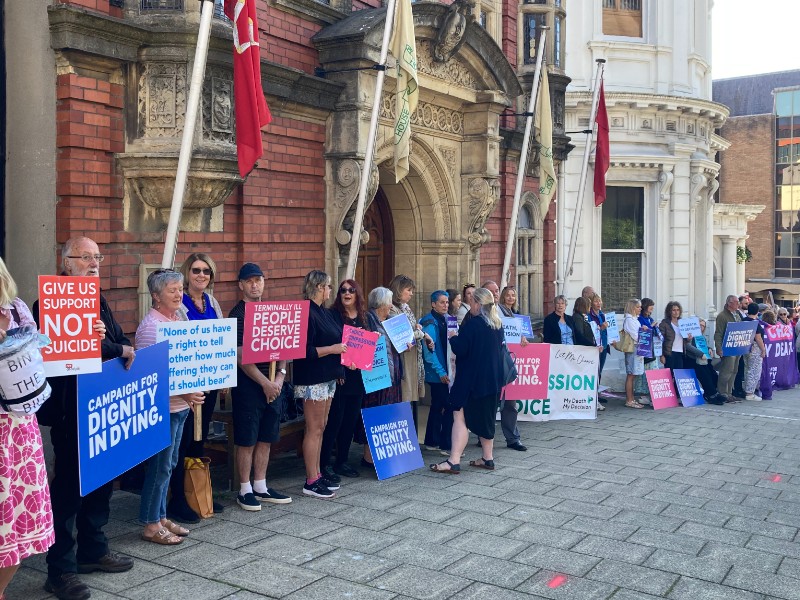
Amendments due to be debated in Tynwald
This week the topic of assisted dying will again be discussed on the floor of Tynwald.
Amendments from the mover of the private members' bill, Dr Alex Allinson, are due to be debated by our Island's politicians.
But will they be approved? And if they are - will the bill get royal assent during this administration?
Or will it be back to the drawing board for a new class of MHKs come the autumn?
A host of questions remain.
DELAY
It's now been over a year since the Assisted Dying Bill completed its passage through the Island's parliamentary branches and was submitted to the UK's Ministry of Justice (MoJ) to seek royal assent.
But in March this year, the UK Government decided that 'certain matters must be addressed directly on the face of the Bill to comply with the European Convention on Human Rights'.
It was on this basis that the Bill has so far been denied the rubber stamp of approval.
The main issue raised by the MoJ was the application of the judgment in Mortier v Belgium, which concerned mental suffering, rather than terminal illness.
In this instance, 64-year-old Godelieva de Troyer, who had suffered from chronic depression for about forty years, underwent euthanasia on 19 April 2012.
According to reporting from Politico, 'the complaint was taken to the court by de Troyer's son, Tom Mortier, who said he wasn't properly informed of the decision to go ahead with the procedure.
In the end, the European Court of Human Rights (ECtHR) ruled in Belgium's favour and did not find issue with the principle of assisted dying itself, but rather the independent post-death review.
It found that 'neither Belgium's legislative framework for euthanasia, nor its application in this particular case, was in violation of Article 2 of the European Convention on Human Rights, which guarantees the right to life. Judges also found that the state had respected de Troyer's right to privacy and family life, which is protected under Article 8 of the convention.
'The judges did find fault with the state in one instance, finding that the Belgian government didn't properly review the case in either the mandatory review conducted by its commission for euthanasia, or in a criminal investigation that followed.'
Dr Allinson says he's 'fairly confident' the amendments tabled tomorrow - if approved by Tynwald - will mean the Bill can now be resubmitted for royal assent:
AMENDMENTS
According to Dr Allinson, the proposed amendments 'strengthen the safeguards of the Bill and put it on a much firmer footing should it ever be challenged in the European Court of Human Rights'.
The Ramsey MHK provided Manx Radio with the explanatory notes regarding the amendments, as given to members of Tynwald, and now available on the Register of Business, which state:
- Amendment 1: 'tightens Tynwald’s control over delegated powers, thereby enhancing the democratic scrutiny of safeguards, so as to ensure that the resulting Act constitutes in principle a legislative framework capable of ensuring the protection of a patient’s right to life'
- Amendment 2: 'imposes an express duty on decision‑makers to consider coercion, vulnerability, and voluntariness and to have regard to the need to safeguard and protect vulnerable adults in accordance with the Safeguarding Act 2018. It moves the system from implicit clinical judgment to explicit statutory obligation'
- Amendment 3: 'has the effect of clarifying independence of doctors and excluding the treating doctors and financially interested persons'
- Amendment 4: '[enhances] the democratic scrutiny of safeguards to ensure that the legislative framework is “capable in principle” of protecting life.'
- Amendment 5: 'guarantees the person’s right to withdraw their request at any time and by any means, thereby reinforcing voluntariness and continuing consent. It prevents coercion crystallising into an irreversible outcome yet strongly supports the autonomy of the person seeking an assisted death.'
- Amendment 6: 'provides a structured mechanism to detect coercion, address vulnerability and ensure decisions are not acted upon while concerns remain. It creates records and an audit trail and so enables an effective review, by ensuring that the post‑death reviewer is able to assess whether triggers were present and whether action was taken'
- Amendment 7: 'requires explicit confirmation that safeguard concerns have been addressed and that the decision is voluntary. It also produces a clear evidential record.'
- Amendment 8: 'tightens Tynwald’s control over delegated powers, thereby enhancing the democratic scrutiny of safeguards'
- Amendment 9: 'requires initial and ongoing training with no opt‑out. This strengthens Article 2 ECHR compatibility by providing capacity for those assisting the person seeking an assisted death to identify coercion, improving quality of decision‑making and ensuring consistency of application. It also indirectly improves reliability of records and assessments.'
- Amendment 10: 'directly addresses the only violation identified in Mortier: by ensuring that there will be a systematic review of cases, with the capacity to establish facts, assess compliance and identify failures. Each review will be independent and timely, with access to full records given to the reviewer, with the ability to refer matters for further investigation.'
- Amendments 11 to 14: 'add to the list of topics that must be included in a code of practice under that section; amend the Tynwald procedure so as to require a code to be laid before Tynwald and must not take effect unless it is approved by Tynwald by Order; and ensures that the Safeguarding Board is consulted before a code is issued under the section. These amendments embed the safeguarding processes, training requirements and decision‑recording, thereby improving standardisation and evidential quality.'
The amendments can be found HERE and the explanatory memorandum HERE.
In short, many of the amendments address concerns which in theory would've been tackled in the Island's secondary legislation, rather than the primary Assisted Dying Bill which has made its way through Tynwald's branches.
"The issue of assisted dying has got popular backing; there are people who have been campaigning for this for decades, and so at this late stage to try to derail the bill getting royal assent at the last moment I think would be fairly counter-productive in terms of overall democracy." - Dr Alex Allinson, mover of the private members' bill
Fellow crown dependency, Jersey, passed its own law to allow terminally ill adults the right to choose to end their own lives in February this year.
It is also awaiting royal assent - but the key difference between the two bills is that the Manx legislation came forward via a private members' bill, whereas Jersey's law was backed by their government from the outset, so much of the wider safeguards are already built in, as Dr Allinson explains:
But will the changes be enough to get the bill through? And even if the amendments are approved by Tynwald, will we see royal assent granted by Westminster during this administration?
Dr Allinson says he's confident the amendments can get approved and royal assent granted; but that this is 'not a quick process' as even then, the long process of implementation gets underway.
He adds even if it does time-out during this administration, he's confident someone else will take up the baton, as he's not the first to have brought the topic to Tynwald:
'RUSHED'
Whilst Dr Allinson says royal assent is just step one before the detailed work of developing secondary legislation and frameworks for implementation, some have expressed their concerns ahead of tomorrow's sitting.
One group which has spoken out is Churches Alive in Mann, which 'represents all the main Christian denominations on the Isle of Man' (Church of England, Methodist Church, Catholic Church, United Reformed Church, Living Hope, Elim Onchan, Salvation Army and Broadway Baptist).
"Given the huge strains on both Hospice and Manx Care budgets, there remain deep concerns about this uncosted Bill. If we don’t commit first to funding Hospice adequately, what choice do people really have at the end of their lives?" - Churches Alive in Mann
It says it is 'deeply concerned' as it believes the amendments 'are being rushed through in a dangerous and unaccountable way', and that they 'don’t offer the protection needed for the most vulnerable in Manx society'.
In a statement, it says whilst it welcomes 'several of the protections put forward in the proposed Tynwald amendments' it has 'deep concerns about both the process and the content'.
It argues 'key protections are too important to rush', saying: "The amendments deal with hugely significant human rights concerns around mental capacity, coercion and reporting. Yet they are being dealt with in a very rushed way, with none of the usual scrutiny of clauses by the House of Keys and Legislative Council. This approach subverts our carefully constructed democratic processes.
"While amendments have on rare occasions been brought straight to the joint sitting of Tynwald, the difference is that these have previously been for minor procedural changes: not for life-and-death human rights issues. Any robust piece of legislation ought to be given the opportunity to withstand the fullest scrutiny. Attention needs to be given to the impact on funding for Hospice and palliative care, and to the significant concerns raised by the Isle of Man Medical Society. The stakes are simply too high for last-minute, time pressured decisions.
'GOVERNMENT SHOULD ALWAYS HAVE BEEN ENGAGED'
Another angle in this debate comes from Douglas Central MHK Chris Thomas.
He believes the public tide has turned in support of assisted dying, and as a result, the current Bill should be scrapped, in favour of a Government-backed Bill (à la Jersey) to be brought to the House of Keys by the next administration after the September General Election:
Addressing the chamber back in May, he told fellow members: "If time runs out on this Bill and this administration, so be it, but the Government is now engaged. The Government should always have been engaged, in my humble opinion."
"I humbly suggest, without bringing it back to this place, the House of Keys, will be cavalier, even reckless. It will be dismissive, even indifferent, to the very serious challenges that beset us. We will be acting without caution, disregarding the potentially harmful consequences of our actions." - Chris Thomas MHK addressing the House of Keys on 5 May 2026
Mr Thomas says the Jersey Bill is 'better than ours' as it was started several years ago with a citizens' jury providing input and also argues there's a limit to how far we can lead the way on complex legislation as we don't stand entirely alone, particularly when taking into account geography.
He cited several structures we are part of as we are in the British Isles, such as the common travel area and wider pharmaceutical processes and regulations.
He argues that both proponents and opponents of assisted dying have summarised the Bill too simply:
Mr Thomas says now that the national focus is on the Isle of Man, we 'have to do this right'.
CROSS-JURISDICTIONAL ISSUES
But if the Bill we already have gets approved (again) tomorrow, and if royal assent is granted, the focus - as Dr Allinson points out - will then turn to the wider implications, including how it works in practice.
One area which will need to be considered is the impact it will have on UK doctors treating Manx patients, both across the water, and here at home as locums.
This is a concern that has been raised by the British Medical Association (BMA), which represents doctors and medical students.
On 14 September 2021, its policy-making body voted in favour of a motion changing the BMA’s policy from opposition to a change in the law on assisted dying, to a position of neutrality.
This means it neither supports nor opposes attempts to change the law, but it does have a responsibility to represent its members’ 'interests and concerns'.
And one of those concerns is what it's deemed the 'cross jurisdictional issue' - essentially, the fact that if the law changes here, it doesn't protect medical professionals from prosecution at home.
"Dr Alex Allinson MHK’s Assisted Dying Bill has passed through the Tynwald in the Isle of Man and now awaits Royal Assent.
"This has significant implications for doctors working in England. Many patients from the Isle of Man receive specialist care in England (often in shared care arrangements paid for by the Isle of Man Government). Those specialist doctors, who are treating patients (in England) who are eligible for – and may wish to choose – assisted dying in the Isle of Man, would still be bound by the terms of the Suicide Act 1961.
"This means that if they do, or say, anything (whilst in England) that might be perceived as ‘encouraging or assisting’ their patients to have an assisted death in the Isle of Man, they would be committing a criminal offence. The same would apply to doctors who, whilst in England, treat patients who live in Jersey legislation which is also awaiting Royal Assent before introducing assisted dying)." - The British Medical Association
The BMA says it has been liaising with UK legislators as a result to find a way to amend the Suicide Act 1961 'to protect doctors who treat patients from other parts of the UK or crown dependencies from this legal risk'.
It said: "An amendment to the Government’s Crime and Policing Bill was tabled by Lord Falconer (at our request) to address this problem.
"This was debated in March 2026, but the Government did not support the amendment, saying it was premature (given that the Jersey and Isle of Man Bills had not yet received Royal Assent) and they had some concerns about the wording of the amendment. The Government agreed however to consult and consider the issue in the future."
CRIME AND POLICING BILL
So, what of that amendment?
It was tabled by Lord Falconer - a proponent of assisted dying - in conjunction with Baroness Finlay of Llandaff - an opponent - in the House of Lords.
But on 2 February this year, Ilora Finlay, withdrew the amendment standing in her name, stating she had been contacted by the Chief Minister, Alfred Cannan, to do so:
'DRAFTED AN AMENDMENT IN GOOD FAITH'
Speaking to Manx Radio, Baroness Finlay said once she was aware that 'key discussions had not taken place' any amendment 'would have been premature and inappropriate':
As aforementioned, the key difference in the Manx Bill versus the Jersey Bill is the use of secondary versus primary legislation.
The crossbench peer told us she believes it would be 'dangerous' to leave some of these key decisions to secondary legislation, particularly when doctors are unclear on where they will stand if the Bill becomes law:
But what does Dr Allinson make of this amendment and the attempts to make our Bill more robust in terms of its implementation and its ripple-effect across the British Isles? And what did he think of the intervention by Mr Cannan? Well, we asked him:
CORRESPONDENCE
A few weeks ago, Manx Radio was informed that the Chief Minister, Alfred Cannan, may have been contacting his UK counterparts regarding the Assisted Dying Bill under his letterhead as chief minister, rather than simply as a concerned MHK.
It's something we put to Dr Allinson, who said it is 'important that we recognise that we have our own parliament, we pass our own laws, we do have a mechanism whereby our laws have to get royal assent, but the democracy and the democratic debate within Tynwald should not try to be undermined':
Manx Radio contacted Mr Cannan for clarification regarding his correspondence.
He told us that Baroness Finlay contacted him to ask whether the Isle of Man Government had been consulted on the detail of the amendment, to which he confirmed it had not, and so she withdrew it as a result.
Their censored correspondence can be found as part of a Freedom of Information request response (5383301), HERE.
As the topic of correspondence with the UK was discussed with regards to the Crime and Policing Bill with Mr Cannan, Manx Radio also asked Mr Thomas if he had been in correspondence with his UK counterparts, given his opposition to the Assisted Dying Bill.
Mr Thomas confirmed that in April 2025 he wrote to the Island's Attorney General Walter Wannenburgh explaining his concerns and asking how to express those concerns to the MoJ.
This included confirmation of contact details for then-UK Lord Chancellor, Shabana Mahmood.
He told Manx Radio he then did utilise those contact details and also gave them to various colleagues to help them 'raise concerns across'.
This was one of two issues former MHK Quintin Gill raised in an open letter to the chief minister published over the weekend, in which he accused Mr Cannan of 'belittling' the Manx parliament. You can find more on that letter HERE.
TYNWALD SITTING
So, what will happen tomorrow in the Island's parliament?
It's not going to be clear-cut, and we'd hazard a guess it won't be a short debate.
But we'll bring you the outcome and keep following this story as it develops.
You can listen across proceedings in the court from 10am live on Manx Radio's AM1368 frequency, online or on smart devices.
You can hear a summary of this report below:
 Marown Commissioners to hold requisition meeting ahead of by-election
 Onchan commissioner will stand again in 2031
 Yellow warning for coastal overtopping to come into force later
 Garff candidates put in 'terrible' position by windfarm advice says new MHK